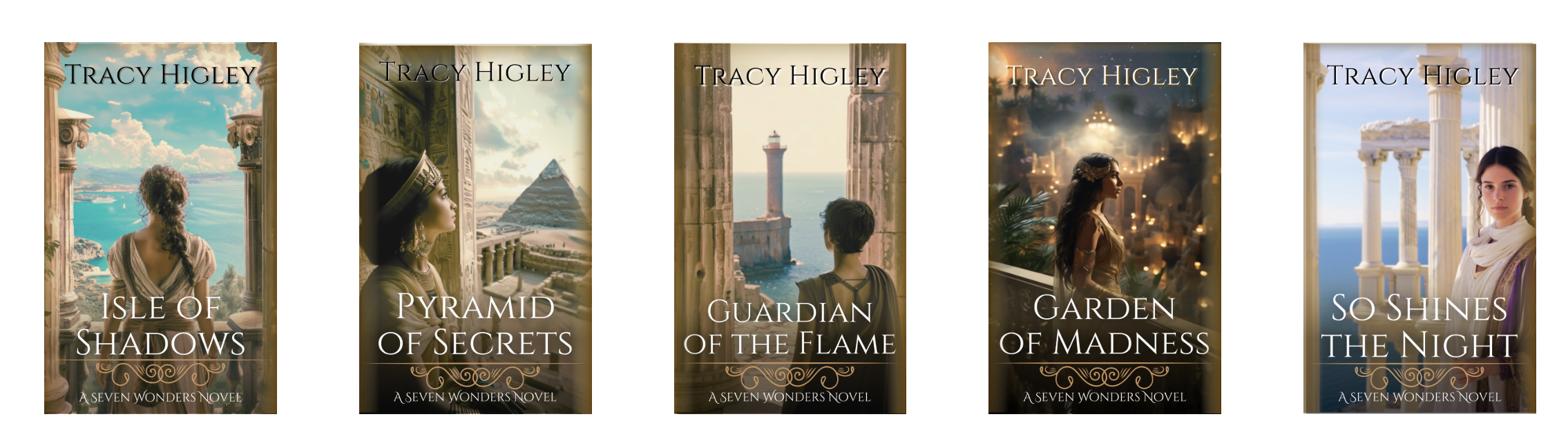
Top Book: Garden of Madness (Hanging Gardens of Babylon)
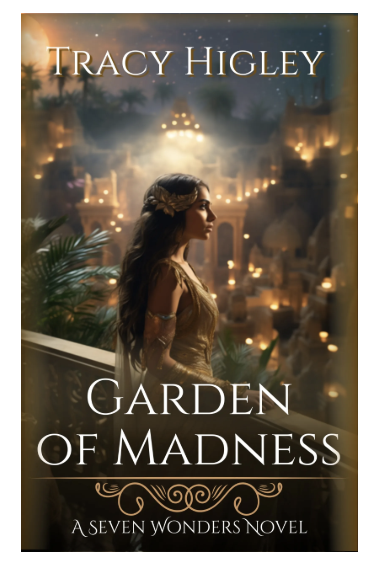
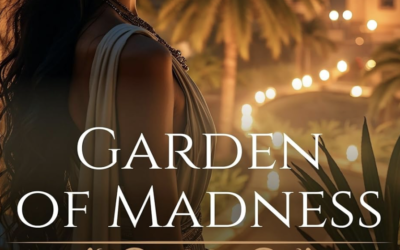
Garden of Madness
Things I loved:
The character of the hero. He was a friend of Daniel. But he was also a man desiring above all else to be faithful to the LORD. At the same time, he struggled with how certain challenges in his life seemed to reflect that he was not as faithful as he thought.
His prayers. I have never in my life read a book AGAIN IMMEDIATELY. But I did with Garden of Madness. I hadn’t bookmarked his prayers and wanted to experience that again. It sent me to the Scriptures to memorize (of others, Psalm 91). How this psalm plays itself out in the book is THRILLING!
The heroine. Spunky and full of life, you’ve certainly known young women like Tia before, and you can see how hard life is for her given her background. Her hobbies are boggling–but seem to be historically possible, which is fun to consider.
The history: When I got to the name Zerubbabel, I looked up his history and was FLOORED by what I discovered online. It made me love the book even more!
Daniel and Nebuchadnezzar. Since my childhood, these two have my absolute favorite characters in the Old Testament. And to see them in this story was like seeing someone from my family show up in a book I was reading. The author’s license in how she expanded on this season of Nebuchadnezzar’s life was true to Scripture, I think honoring to God, and shows in a delightful story what passes as a paragraph in the Book of Daniel.
The way the enemies to lovers worked itself out was phenomenal. As the cherry on the top of this series about darkness and light in the ancient world, the prayers of the Jewish man show the amazing GRACE and KINDNESS of God, even during the Babylonian Captivity.
2nd Place: Pyramid of Secrets (Pyramids of Egypt)
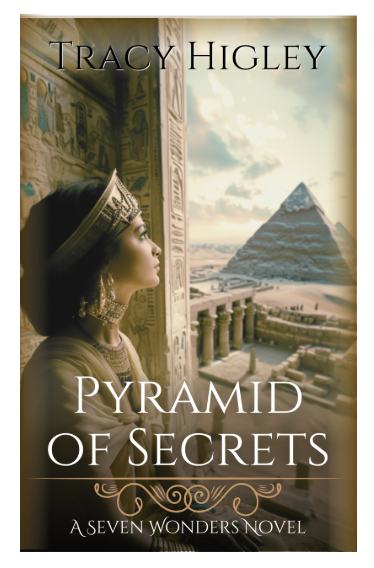
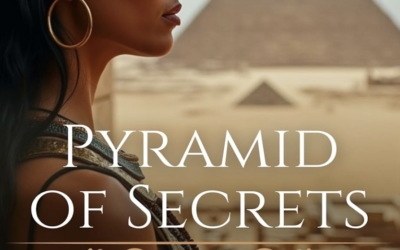
Pyramid of Secrets
As the second book I read in the series, the beginning was a bit hard to understand. The darkness and the confusion.
But pressing on, it became my second favorite of the series–because of that very darkness.
What I loved:
The characters live during the building of the pyramids, so during the Old Kingdom, 3000 BC or so, so much earlier than even Abraham (who lived in 2000 BC).
How in the world can you find HOPE for people living in darkness in a world where even Abraham has not been called (or even born) yet?
The masterful way in which the author accomplished this won me heart and soul into reading the entire series.
Where, indeed?!
The main character is attempting to manage the building of the pyramid while at the same time doing detective work into the death of his dear friends who keep dying in similar tragic ways.
As he investigates these deaths, he is drawn into a mysterious world he did not know existed in Egypt. And as he finds resolution for the gruesome deaths, he likewise finds resolution for the great darkness that has trapped him and his people and all the people in the Ancient Near East.
WOW. That RAY OF LIGHT right there–was profoundly beautiful to see. Well done, Tracy Higley!
3rd Place: Guardian of the Flame (Library & Lighthouse of Alexandria)
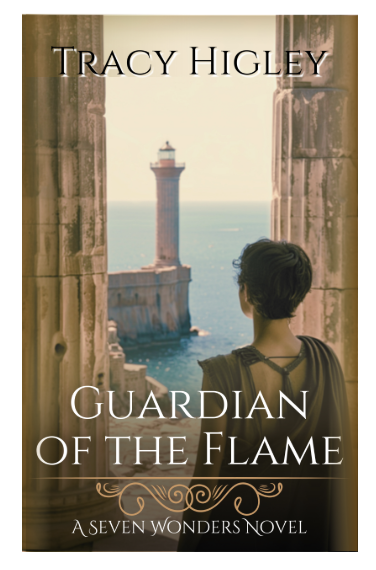
Guardian of the Flame
The next three stories might be equal in different ways, so hard to rank.
But what I loved about this one was first of all, the Antikythera Device being referred to and “explained,” because indeed my own Detective Tim Reynolds has his understanding of that!
But aside from that AMAZING ANCIENT MYSTERY, the age of Sophia the protagonist-heroine, was lovely. They called her an “old woman,” though she was probably closer to middle-age. They called her “no longer beautiful,” and yet those who REALLY KNEW HER saw both her pain and her beauty still in spite of her loss. And we got to know her from their eyes.
Sophia’s LOSS–and reason for hiding in the tower–was so gripping, especially when you learn the extent of it. And the enemies to friends arc contrasting the friends to enemies arcs were engrossing.
The FRIENDSHIP based on literature and knowledge, and how even in ancient Alexandria–amidst Julius Caesar and Cleopatra, the Library of Alexandria and the Lighthouse of Alexandria–, meaning, before Christ–there was still HOPE in the Ancient World.
Available, though hard to find.
The redemption arcs in this were so rewarding. and the TWIST OF ALL TWISTS?? Unforgettable!
4th Place: Isle of Shadows (Colossus of Rhodes)
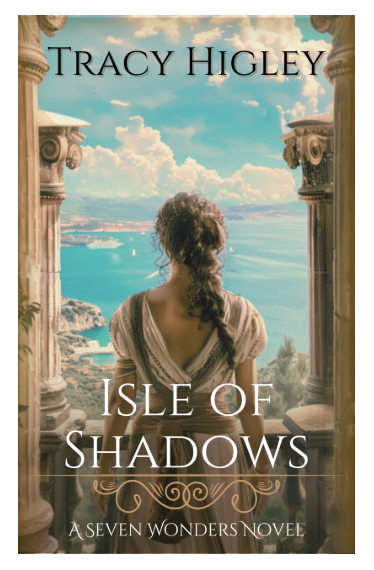
Isle of Shadows
This was the first book I read in this series, coming off of my enjoyment of the Sahara Aldridge Time Travel series.
I did not know what THIS series would be about, simply thinking it would be about the Seven Wonders, which is a lifetime favorite subject of mine, the Ancient World always being in my life–even today where I live.
This story follows Tessa, who lives under the Shadow of Colossus of Rhodes. She lives a life of false luxury, as a mistress of a rich and despicable man. And yet, she is educated and valued for her wise understanding of society and politics.
As a foray into the ancient world, and on the tale end of the non-religious Sahara Aldridge series, I was not expecting to meet a Jewish man. I especially was surprised when this Jewish man became central to the story.
Her accidental “rescue” from one trouble sends her on an adventure to uncover a conspiracy all the while covering up her own dark secrets.
Then there is a mysterious stranger who enters her world.
What I loved about this story was the faithfulness of the Jewish population of Rhodes, BC. And how these Jews reflected an awareness of the need to share the One God with those who would hear.
It turns out, this is a prime assumption in the series, which is a very hopeful premise. But do we know if believers in Yahweh shared their faith with anyone outside of their families? 🤷♀️ That’s what makes this a bit speculative–in a very evangelistically flavored way.
5th Place: So Shines the Night (Temple of Diana at Ephesus)
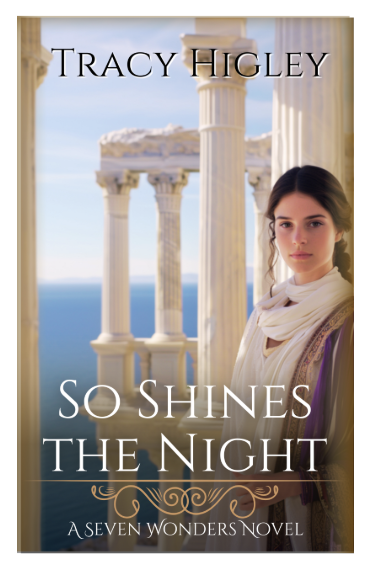
So Shines the Night
As I place this book as 5th place, I cringe at the meaning that it might be seen as the “worst” of them all.
Not so.) It’s just that, in all of its beauty, it ends up here. We meet Daria as an educated young woman-teacher training other women–in Rhodes. So she has an unusual, but very likely, love of learning in the age of the Early Church.
After a meaningful series of mishaps, she meets a merchant who wants to learn Persian, so is hired to be his tutor and returns with him to Ephesus.
This is Ephesus of St. Paul, Timothy, Aquilla and Priscilla.
Now I know Ephesus like the back of my hand. Having lived in Smyrna (Izmir) Turkey for almost 30 years, I have visited Ephesus more times than most people.
So I knew the harbor and the cliff houses and the location of the amphitheatre and the general direction of the School of Tyrannus. I knew the little shops where mysterious goings-on could go-on. I knew the streets and the paths and where the prostitute’s brothel is.
I knew how to go up the steps to get to the merchant’s house. I know the view you’d have from his terrace. I could see it in my mind’s eye and was amazed at Tracy Higley’s accurate use of these locations.
But likewise, I know how long it takes to walk from the terrace houses, past the harbor, to Artemis’s temple. So it puzzled me how some of the timing worked. But anyhoo–
The story shows the abject darkness of both idolatry and sorcery in the ancient world. And it shows the simple power of the Name of Christ that overthrows the powers of darkness.
If you go to Ephesus today, there is a new exhibit that is a multi-media, 5D adventure into Ancient Ephesus: The Ephesus Experience. You enter in and the rooms become a travel to the past. You walk with others from the harbor toward the amphitheatre. You feel the mist coming in from the sea as you are shown the growth of the cult of Artemis in Ephesus from the beginning of its oldest days.
But, by the end of the exhibit, (apparently) the creators want the participants to feel an anger at Christianity for being the CAUSE of the destruction of the “beautiful Temple of Artemis.”
This book, I think, is a much better way to experience that change. Because the freedom that comes to Daria (and others) because of Paul and (wink-wink) Timothy gives a much more satisfying Ephesus Experience with an amazingly (mostly) accurate representation of the city plan of Ephesus.